

Insights
10 Feb 2026
UKGBC estimate that 80% of current UK whole life building emissions are attributable to operational carbon. However, due to the ongoing grid decarbonisation, the proportion of emissions attributable to embodied carbon is set to exceed operational carbon by c.2035. Collective focus over the last 30-years has been on minimising operational carbon emissions, however a paradigm shift must now occur to begin to switch focus to embodied carbon emissions and addressing what is set to become the majority of built environment carbon emissions within the next decade.
The EU has already acted on this and is beginning to phase-in embodied carbon regulations through the introduction of the Energy Performance of Buildings Directive (EPBD). Meanwhile, the UK’s own drive to implement national embodied carbon regulations appears to have stalled.
The best policy currently in place is Scotland’s National Planning Framework 4 (NPF4), which must be considered alongside local development plans. This came into effect in February 2023 and includes Policy 2 which sets out how the overarching requirement for all Scottish development proposals to be ‘sited and designed to minimise lifecycle greenhouse gas emissions as far as possible’. This policy remains the closest example of a national policy in the UK showing consideration to whole life carbon assessments (WLCAs).
Elsewhere, in England, Part Z was first introduced to parliament in 2022, however political support on the issue has since stalled, in spite of wider support from the industry in general. Meanwhile the existing National Planning Policy Framework provides an overall requirement for the impacts of climate change to be mitigated, however the draft update currently being consulted on is slightly more forceful in requiring development plans to take a ‘a proactive approach to mitigating climate change and supporting the transition to net zero’. Furthermore, Wales’ Planning Policy 12 (2024) simply encourages the use of low carbon material, whilst Northern Ireland’s Strategic Planning Policy Statement still primarily focuses on operational carbon, with any embodied carbon reduction currently deemed voluntary.
The impending release of the UK Net Zero Carbon Building Standard (NZCBS) in early 2026 introduces an IPCC Paris Agreement aligned definition for net zero buildings, therein driving decarbonisation and the uptake of embodied carbon/WLCAs. However, as a voluntary standard, at least to begin with, this will primarily be driven by market factors and developer ambition.
Overall, the lack of any national regulation has left individual local authorities to set their own priority and policy on the matter, leaving an inconsistent, and therefore unhelpful, adopted approach across the UK. Hollis have therefore undertaken an examination of some of the UK’s major towns and cities (making up over a third of the UK’s total population) to analyse their current policies in relation to embodied carbon and to shed some light on (at the time of writing January 2026).
Through the research, Hollis have found that of the 18 local authorities examined across the country, only four of these were found to have no active or emerging planning policy mandating for the assessment of embodied carbon emissions. This means that 78% of these were found to have either active policy or to be formulating embodied carbon policy within their policy updates.
Summary of the findings of the UK embodied carbon regulations research
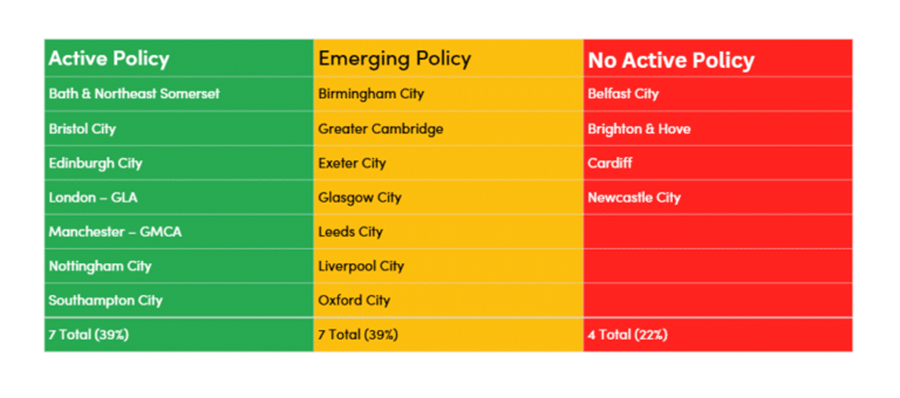
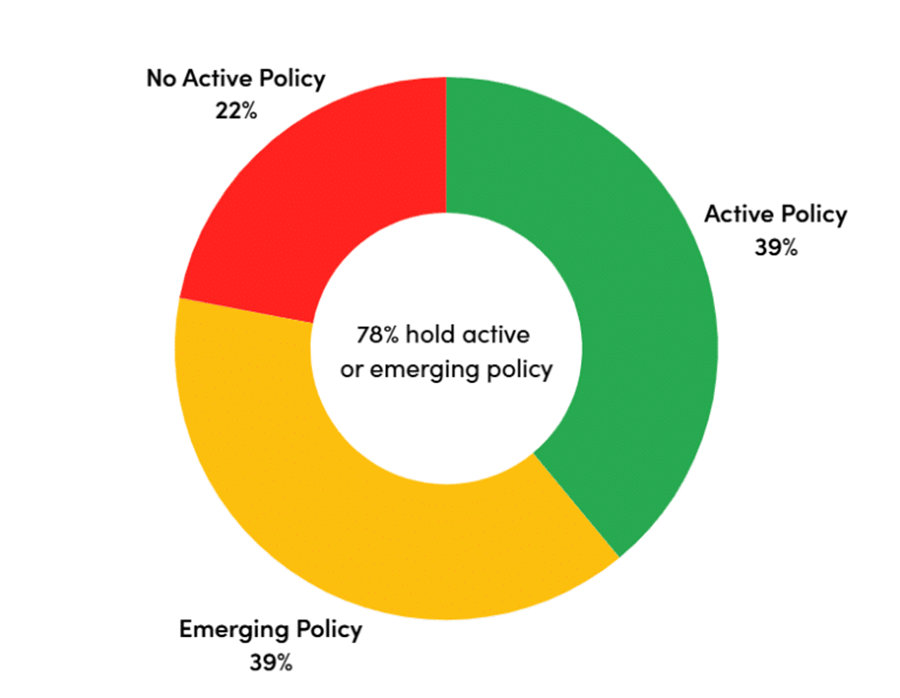
Whilst the findings are not a direct proxy for the state of the UK’s local planning regulations, these numbers provide some indication that the majority of authorities appear to either be explicitly demanding embodied carbon to be considered on new developments, or to be formulating policies to ensure that that is the case in the near future. Many of the local authorities are in the process of updating outdated planning regulations and it appears that with these updates, they are taking the opportunity implement regulation.
The population of the towns listed make up over a third of the UK population and therefore amount to a significant proportion of UK real estate demand. For developers, the message appears to be simple: embodied carbon regulation is coming, if it hasn’t already arrived. If assessing embodied carbon isn’t already a regular occurrence on projects, it will need to be in the near future. Addressing embodied carbon on projects now enables your teams to build up experience of working with different materials and methodologies and for early lessons to be learnt. This will provide teams with time to test out solutions on a smaller scale before upscaling further down the line and being ready for when regulations do come in. Overall, taking decisive action on embodied carbon now will give the doers an advantage over other lagging competition.
Finally, all of this has omitted mention of the fact that we are in a climate crisis and the time for indecision is over. Immediate action is needed to limit emissions to as close to the 1.5°C target as possible and therefore acting on embodied carbon marks a significant step towards this. There is an ethical responsibility to take ownership on the issue to reduce burden on both current and future generations, but there are also social benefits associated with mitigating climate change, with each tonne of CO2esaved providing around £252 of societal benefits. Furthermore, embodied carbon reduction actions are often seen as only a cost burden on projects. Excluding the benefits mentioned above, carbon reduction actions such as improving material efficiency and re-using redundant materials and can in fact reduce project costs. Consequently, implementing embodied carbon assessments as a standard practice will enable developers to realise the associated benefits of proactive measures more promptly.
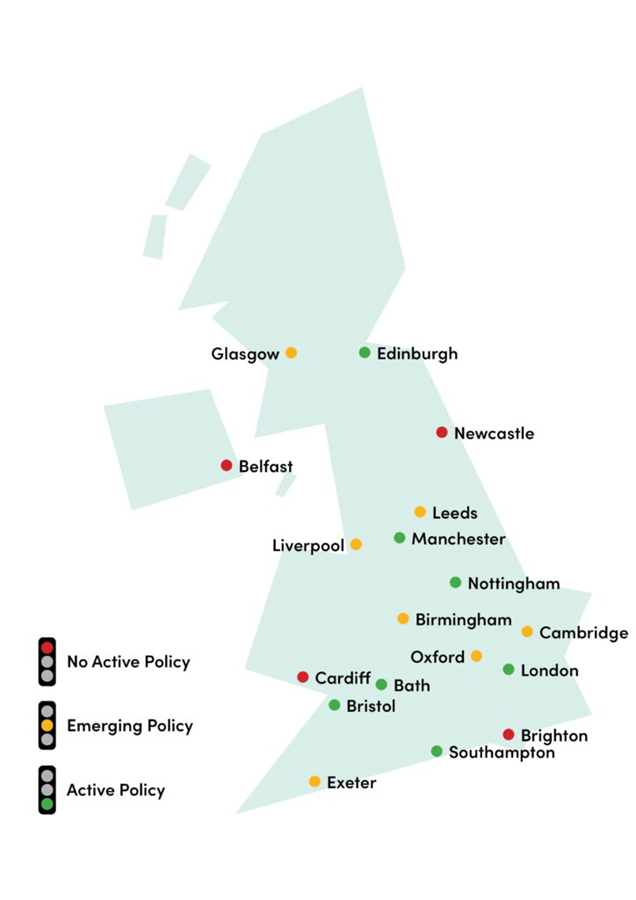
The findings of our research can have been summarised using the accompanying map of the UK and the following summary paragraphs for each local authority assessed.
To explore how Hollis can assist you with your embodied carbon or whole life carbon projects, please get in touch with Cameron Parker.
- Bath & Northeast Somerset – Active Policy
A partial update to the Bath and North East Somerset Local Plan, issued in January 2023, included the adoption of Policy SCR8 and the Sustainable Construction Checklist (SPD) which requires major developments to demonstrate an upfront embodied carbon intensity of ≤900kgCO2e/m2. There is currently no whole life carbon (WLC) requirement.
- Belfast City Council – No Active Policy
The city currently does not require any form of embodied carbon or whole life carbon assessment to be undertaken, however all developments proposals must submit a Climate Change Statement. Again, whilst there is no specific embodied carbon reporting requirement for these statements, larger major developments are increasingly being asked to include some carbon figures.
- Birmingham City Council – Emerging Policy
Birmingham City Council recently undertook a public consultation, which ended in December 2025, focusing on the preferred options for the ongoing local plan review. One such proposed policy, Policy CE3, focused on embodied carbon and is set to implement reporting requirements.
The council is currently targeting adoption of the new Local Plan in September 2027,therefore there is unlikely to be any regulatory requirement until then. However, as with other council’s across the country, Hollis expect that the council will begin to request supporting calculations in the run-up to that publication.
- Brighton & Hove Council – No Active Policy
Brighton & Hove Council currently do not have any mandatory embodied carbon reporting requirements. The council is undertaking a consultation on the inclusion of whole life carbon reporting requirements, however there is no programme for its implementation. As such, the undertaking of such calculations is currently only encouraged for planning applications.
- Bristol City Council – Active Policy
Since November 2023, the Bristol Local Plan has included Policy NZC3,dedicated to tackling WLC by requiring major development to achieve both upfront and WLC benchmarks, with any shortfall against the upfront carbon targets to be offset through a financial contribution towards the council’s carbon offset fund. The sum of which is ‘tied to the high scenario in the Valuation of Energy Use and Greenhouse Gas supplementary guidance to the Treasury’s Green Book’.
- Greater Cambridge – Emerging Policy
Greater Cambridge (Cambridge City Council and South Cambridgeshire District Council) is, at the time of writing, currently in the process of undertaking a consultation on its draft Local Plan. This includes the requirement for all major development to ‘demonstrate actions to reduce up-front embodied carbon emissions’. As such, embodied carbon regulation is likely to come into force from 2027 at the earliest, although it is likely that major development may be asked to begin responding to this policy ambition immediately. Based upon Hollis’ project experience in Cambridge, we have found this to be the case.
- Cardiff Council– No Active Policy
There is no current requirement for development in Cardiff to measure embodied carbon, with the closest match being Local Plan Policy KP15 which loosely requires proposals to show consideration for ‘reducing carbon emissions. Section 5.5 of the ‘Planning for Sustainable Buildings’ Practice Guidance published in 2014 provides advice on embodied carbon reduction actions, but lacks any actual policy requirements for undertaking embodied carbon or WLC calculations. The council does however have their own 2030 net zero targets and therefore hold ambitions to take action on climate change. It may then be that consultations begin in the near future, on how best to begin assessing embodied carbon on new development.
- Edinburgh City Council – Active Policy
Whilst acknowledging the requirements of NPF4 to ‘minimise lifecycle greenhouse gas emissions as far as possible’, Policy Env 7 of the Edinburgh City Plan 2030 requires proposals to demonstrate how WLC emissions have been minimised and materials designed for re-use at their end-of-life. Proposals including demolition of an existing asset must also assess the WLC of the new asset compared to the re-use of the existing asset.
- Exeter City Council – Emerging Policy
Exeter have a new draft local plan, currently in its final iteration and submitted to the planning inspectorate in September 2025 for final approval. Policy CC6 of the draft local plan includes the requirement for major development to calculate embodied carbon emissions and demonstrate carbon reduction actions employed. Minor residential development proposals, which include the replacement of a building, will also be required to demonstrate that the new development will perform better than the refurbished building in terms of life cycle carbon.
- Glasgow City Council – Emerging Policy
Whilst acknowledging the requirements of NPF4 to ‘minimise lifecycle greenhouse gas emissions as far as possible’, Glasgow City Council (GCC) has also undertaken its own research with One Click LCA to assess the impact of introducing an embodied carbon policy and how best to approach this. As such, whilst the existing local development plan does not directly specify the requirement for an assessment, the ambitions of GCC and the requirements of NPF4 mean that WLCAs are not increasingly required as part of proposals.
- Leeds City Council – Emerging Policy
In response to their declaration of a climate emergency and 2030 carbon neutral target, Leeds City Council is in the process of updating their Local Plan, with the most recent consultation having occurred between July and September 2024. Whilst the outcomes of the consultation are yet to be released, the draft policies consulted on included Policy EN1 Part A which sets out the requirement for all major development to undertake a WLCA and to demonstrate reduction. The policy has also left open the option of introducing benchmarks to be achieved at a later stage.
- Liverpool City Council – Emerging Policy
There is currently no active policy relating to embodied or WLC within Liverpool. However, Liverpool City Council is currently in the early stages of updating the existing local plan, with the first round of consultation undertaken between September and November 2025.This draft included Policy STP11 which sets out the requirement for proposals to demonstrate how they WLCAs are to become a requirement in the future and increasingly requested by the council in the meantime.
- London (Greater London Authority – GLA) – Active Policy
London has been leading on the implementation of WLC policy within the UK, requiring WLCAs to be undertaken (in accordance with RICS v1 methodology) since the release of the latest version of the London Plan in 2021 and Policy SI 2. Now at 5-years’ old, the plan is currently in the process of being updated to update the requirements to align with the RICS v2 methodology, with consultation being undertaken to investigate how elements of the UK NZCBS could also be implemented. It should also be noted that individual boroughs may also have their own requirements, with some largely falling in line with GLA guidance, whilst others, such as Camden and the City of London requiring more detailed analyses to be undertaken.
- Manchester (Greater Manchester Combined Authority – GMCA) – Active Policy
The GMCA is the combined planning authority for Greater Manchester, led by the Mayor of Manchester. As the GLA does for London, the GMCA sets out overarching planning policies for proposals to achieve, in addition to the individual criteria set by individual authorities. In 2025, the GMCA released their ‘Design Guidance for Net Zero’, setting out sustainability guidance for applications to follow. Chapters 2 & 4 of the guidance includes the stipulation that major development should submit their upfront carbon emissions using the RICS v2 methodology, for which benchmarks have been set out for small minor, minor, major and large major development to achieve. Larger development are also encouraged to submit a full WLCA.
- Newcastle City Council – No Active Policy
Newcastle does not currently mandate for development proposals to undertake any form of embodied carbon analysis. The council’s Net Zero Newcastle group most recently released a ‘Priority Actions Update’ for 2024 which included “exploring tracking and reducing embodied carbon or whole life cycle emissions in the cities new building stock”. This is primarily based around testing the application of the upcoming UK NZCBS on some of the city’s new buildings. With the standard due for release in early 2026, it would appear that the council will seek to integrate the findings from its release into their planning policy in due course, however no timeline has been provided.
- Nottingham City Council – Active Policy
In June 2025, Nottingham City Council and Broxtowe Borough Council released a joint SPD targeting the ‘Reduction of Carbon in New Development’. This document stipulates how to comply with Policy 1 of the Nottingham ACS, requiring the upfront embodied carbon calculations to be undertaken and reductions demonstrated. Whilst there aren’t any benchmarks to report against, projects are expected to set embodied carbon targets of their own, which must be achieved upon practical completion.
- Oxford City Council – Emerging Policy
From June-August 2025, Oxford City Council undertook a consultation on the ‘preferred options’ for their Oxford Local Plan 2045. The plan, which aims to be submitted to the planning inspectorate in 2026, includes Policy R2 which specifically focuses on tackling embodied carbon, requiring all development to show how it has been considered. Larger new-build developments (≥100 dwelling or ≥10,000m2non-residential floor space) will be required to submit a formal WLCA and demonstrate carbon reduction actions taken throughout the design process.
- Southampton City Council – Active Policy
Like many authorities, Southampton City Council are in the process of updating their Local Plan, with the most recent consultation between October 2022 to January 2023. The draft document consulted on included 3 alternative approaches to embodied carbon, which are yet to be decided upon. In the meantime, however, Southampton have released ‘Energy Guidance for New Developments 2021-2025’ which prescribes a requirement for all development to demonstrate a reduction in embodied carbon of 40% or a carbon intensity of ≤500kgCO2e/m2(GIA).